
FRESH AIR.
WITHOUT OPENING THE ROOM.
A compact balanced ventilation system developed for sealed home cinemas, studios and other sound-isolated rooms — combining up to 150 m³/h air exchange, >80% heat recovery, advanced filtration and app control.
Great sound isolation
creates another challenge.
Effective sound isolation requires the cinema to be sealed from the surrounding building. Walls, ceiling, floor and doors are engineered to minimize air leakage and structural transmission.
But once the room is sealed, the people inside still need fresh air. CO₂, heat and humidity can build rapidly during a movie — particularly when several people occupy a relatively small cinema.
CineVent 150 is designed to provide controlled supply and extract ventilation without relying on an open door or simple passive vents that compromise the purpose of a sealed cinema.
Exhaust stale air.
Bring fresh air back in.
CineVent simultaneously extracts used air and supplies filtered outdoor air. The two air streams pass through a heat exchanger without being mixed, allowing much of the thermal energy in the outgoing air to be recovered.
Extract
Warm, stale air is continuously removed from the cinema.
Recover
More than 80% of the thermal energy can be recovered through the heat exchanger.
Filter
Incoming air passes through the CineVent multi-stage filtration system.
Supply
Filtered fresh air is supplied back into the sealed room.
Exchange the air.
Keep most of the heat.
Simply exhausting warm cinema air would continuously throw away much of the energy already used to heat the room. CineVent transfers thermal energy between the outgoing and incoming air streams, recovering more than 80% under suitable operating conditions.
This is particularly useful for cinemas that are not occupied every day: ventilation can be maintained while significantly reducing the thermal penalty compared with basic extract-and-supply ventilation.
Fresh air and cooling
are two different jobs.
CineVent exchanges the air in the room. A heat pump or air-conditioning system primarily treats the air already inside it. In high-performance cinemas, the two systems can therefore complement each other rather than replace one another.
Exchanges the air
Removes stale air, introduces filtered outdoor air and helps control CO₂ generated by the occupants.
Controls temperature
Provides active heating or cooling, but normally recirculates the existing room air rather than providing the required fresh-air exchange.
Designed for occupied cinemas.
Not just empty rooms.
People are normally the dominant source of CO₂ in a sealed cinema. Required ventilation therefore depends not only on room size, but also on the number of occupants.
Lower airflow for light occupancy and reduced ventilation demand.
Balanced everyday operation for typical cinema use.
Maximum air exchange for higher occupancy and increased demand.
20 m² cinema · 4 occupants
Using the ventilation guideline of 1.2 m³/h per square metre plus 26 m³/h per occupant:
Actual ventilation requirements depend on room design, occupancy, applicable building regulations and the desired indoor-air-quality target.
Know what is happening
inside the room.
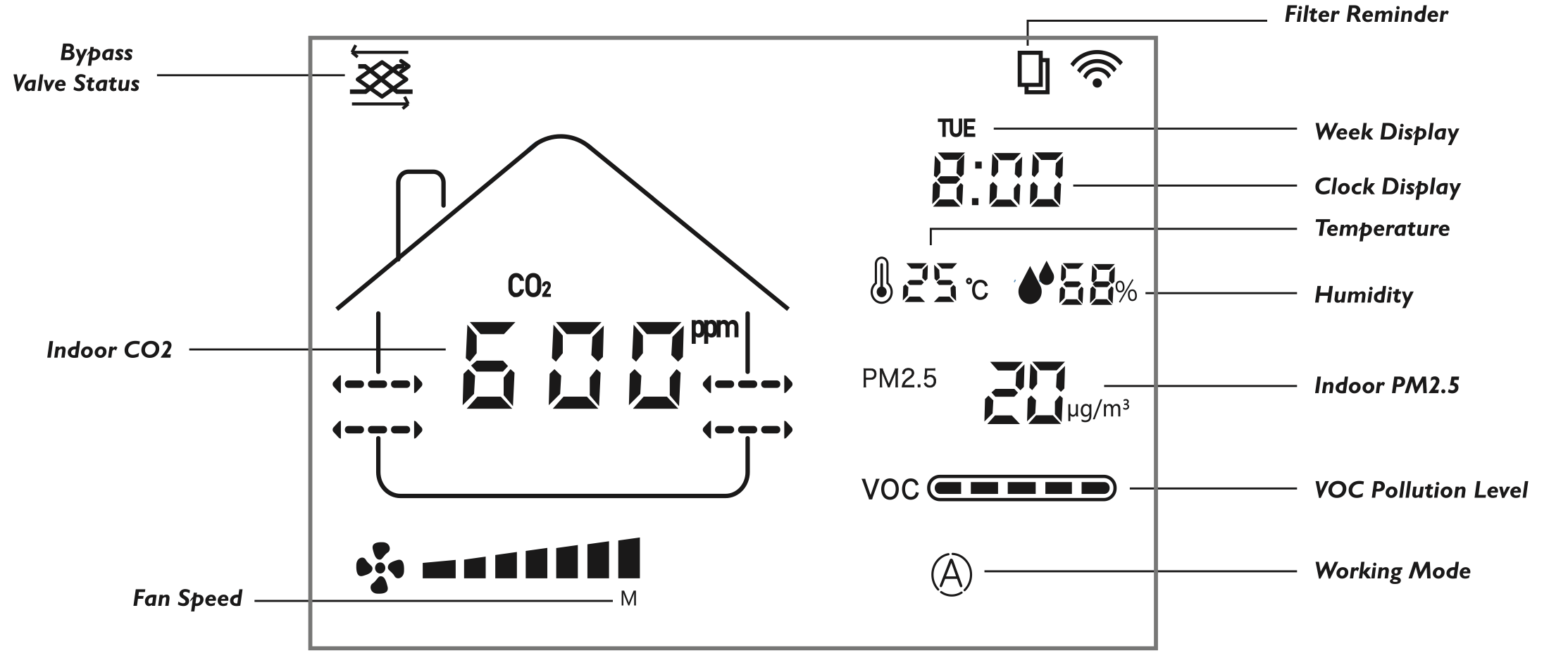
CineVent 150 includes a wired control system providing access to important operating and indoor-air parameters. The unit can also be controlled from a smartphone through the Tuya platform.
Don't just exchange the air.
Filter it.
Incoming air passes through multiple filtration stages designed to reduce dust, airborne particles and odours before the air enters the cinema. This is particularly useful in dedicated rooms where equipment, acoustical treatments and dark surfaces make dust control important.
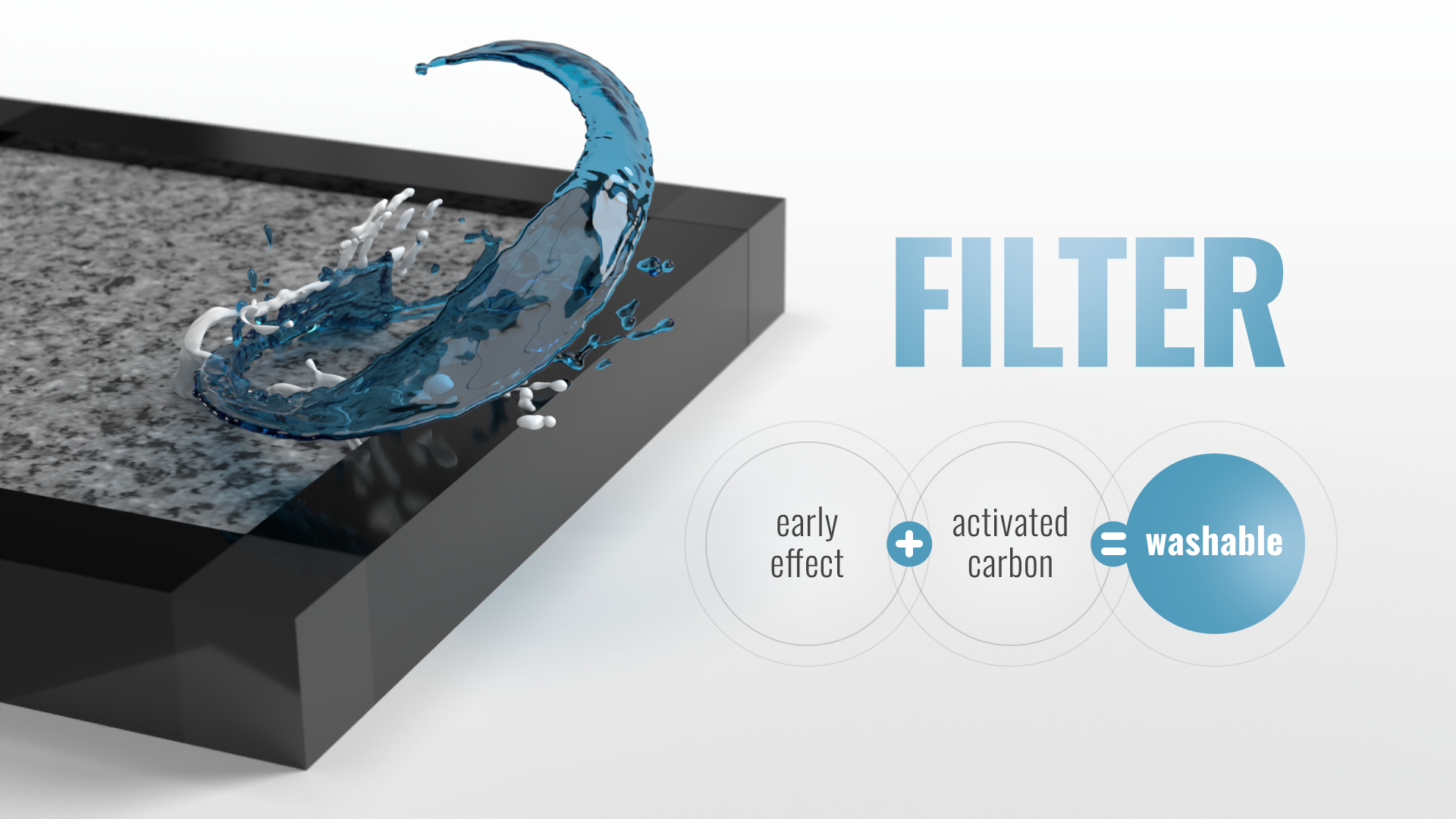
Activated-carbon pre-filter
The first stage uses composite fibre with activated carbon to capture larger dust particles and help reduce odours while maintaining low airflow resistance. The pre-filter is washable and reusable.
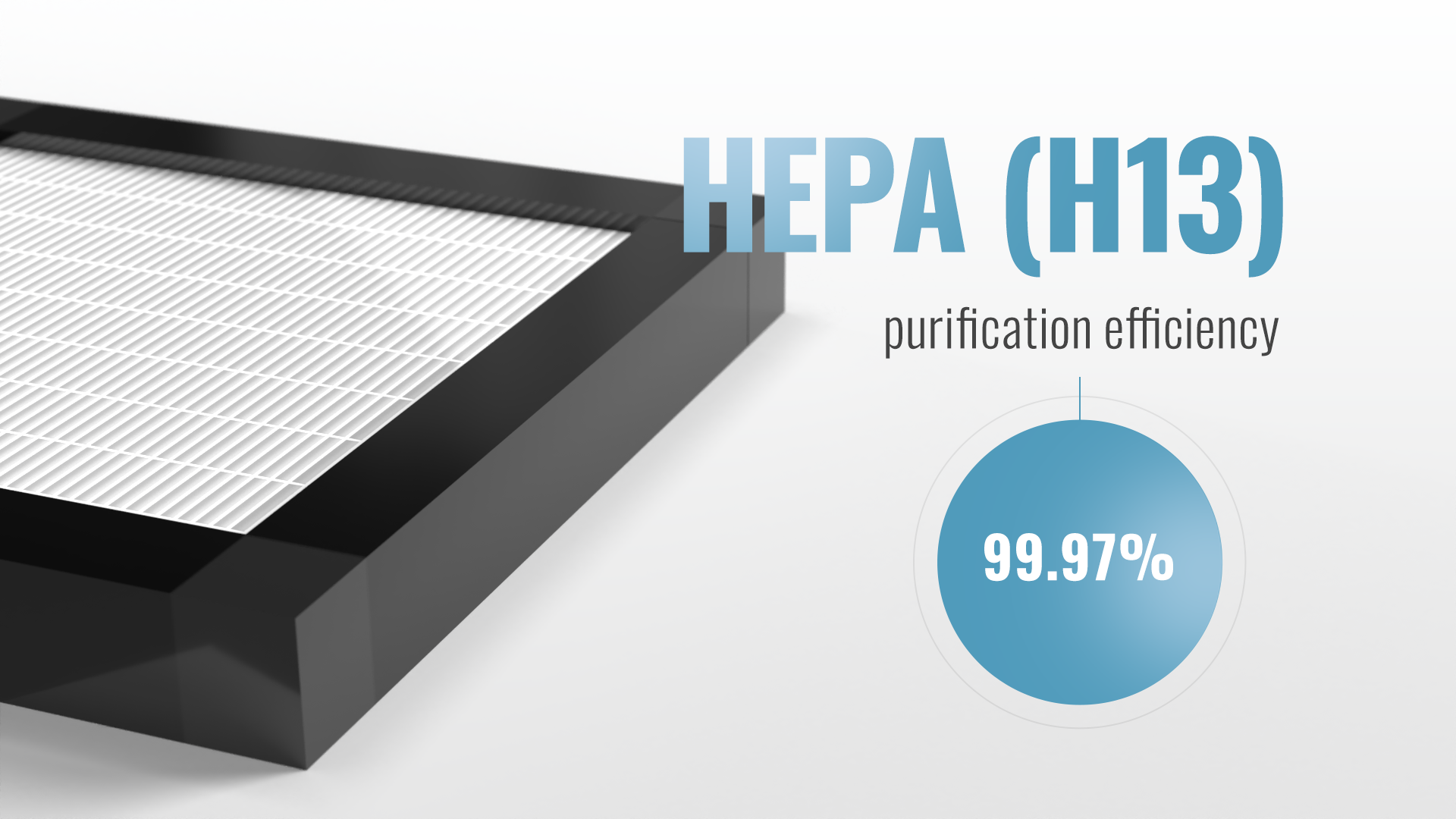
3M H13 HEPA filtration
The secondary 3M-manufactured HEPA filter is specified to H13 level and provides high-efficiency removal of fine airborne particles, including PM2.5.
Electrostatic particle collection
The final stage uses a washable high-voltage electrostatic collector as an additional particle-control stage, complementing the mechanical filtration before the fresh air enters the room.
Only 182 mm high.
CineVent 150 uses a low-profile enclosure measuring only 182 mm in height, allowing the main unit to be integrated into suitable wall or ceiling constructions rather than occupying valuable cinema space.
Four Ø100 mm duct connections provide separate supply and extract paths for the indoor and outdoor air streams.
The ventilation system is only
part of the acoustic solution.
In high-performance sound-isolated rooms, duct routing, penetrations, air velocity and acoustic attenuation must also be considered. Ventilation should be designed so that the air path does not become a flanking path around the sound-isolation construction.
CineVent 150 specifications
| Installation | Wall or ceiling |
| Dimensions | 824 × 752 × 182 mm |
| Weight | 21 kg |
| Heat recovery efficiency | >80% |
| Duct connections | 4 × Ø100 mm |
| Airflow · Low | 75 m³/h |
| Airflow · Medium | 100 m³/h |
| Airflow · High | 150 m³/h |
| Filtration | Activated-carbon pre-filter + H13 HEPA + electrostatic particle collection |
| Filter service | Inspect regularly; typical HEPA replacement up to twice per year depending on operating environment |
| Control | Wired controller + Tuya app control |
| Supply voltage | 220V |
| Power consumption | 82 W |
Installation drawing

Installation & operation
See the CineVent 150 user manual for installation requirements, connections, operation and maintenance.
Download manual — English (PDF, 2026-10-23)
Seal the cinema.
Not the people inside it.
Balanced ventilation for dedicated cinemas and other sealed, sound-isolated rooms — with heat recovery, advanced filtration and up to 150 m³/h of fresh-air exchange.
Find a dealer or contact DreamScreen