
FLOAT THE FLOOR.
CONTROL THE ENERGY.
A progressive multi-stage isolation system developed to mechanically decouple floating floor structures from the building below — with particular emphasis on low-frequency structure-borne sound, impact energy and vibration.
A floating floor should
actually behave like a spring.
Traditional impact-sound solutions are often relatively stiff. This can work well higher in frequency, but low-frequency energy and heavy structure-borne vibration are significantly more difficult to control.
FluxCore U-Boats create a controlled resilient separation between the new floating floor structure and the building below, using a progressive spring response rather than a single homogeneous rubber element.
Soft at low load.
Progressively more stable.
The FluxCore geometry and silica-gel construction are designed so that different parts of the isolator engage progressively as the applied load and movement increase.
Soft response
High compliance allows low-energy vibration to produce useful spring movement.
Controlled travel
Additional parts of the isolator progressively contribute to the spring characteristic.
Increased resistance
Mechanical resistance rises progressively to maintain stability under heavier floor loads.
Stable isolation
Compliance for isolation combined with stability for normal room use.
Designed for the frequencies
that are hardest to stop.
Low-frequency structure-borne sound is particularly challenging because conventional floor-isolation materials can have relatively high dynamic stiffness and corresponding resonance well inside the bass range.
FluxCore U-Boats are designed to move the resonance of the floating floor substantially lower, towards approximately 10 Hz under appropriate loading, helping improve isolation through the critical 20–80 Hz region.
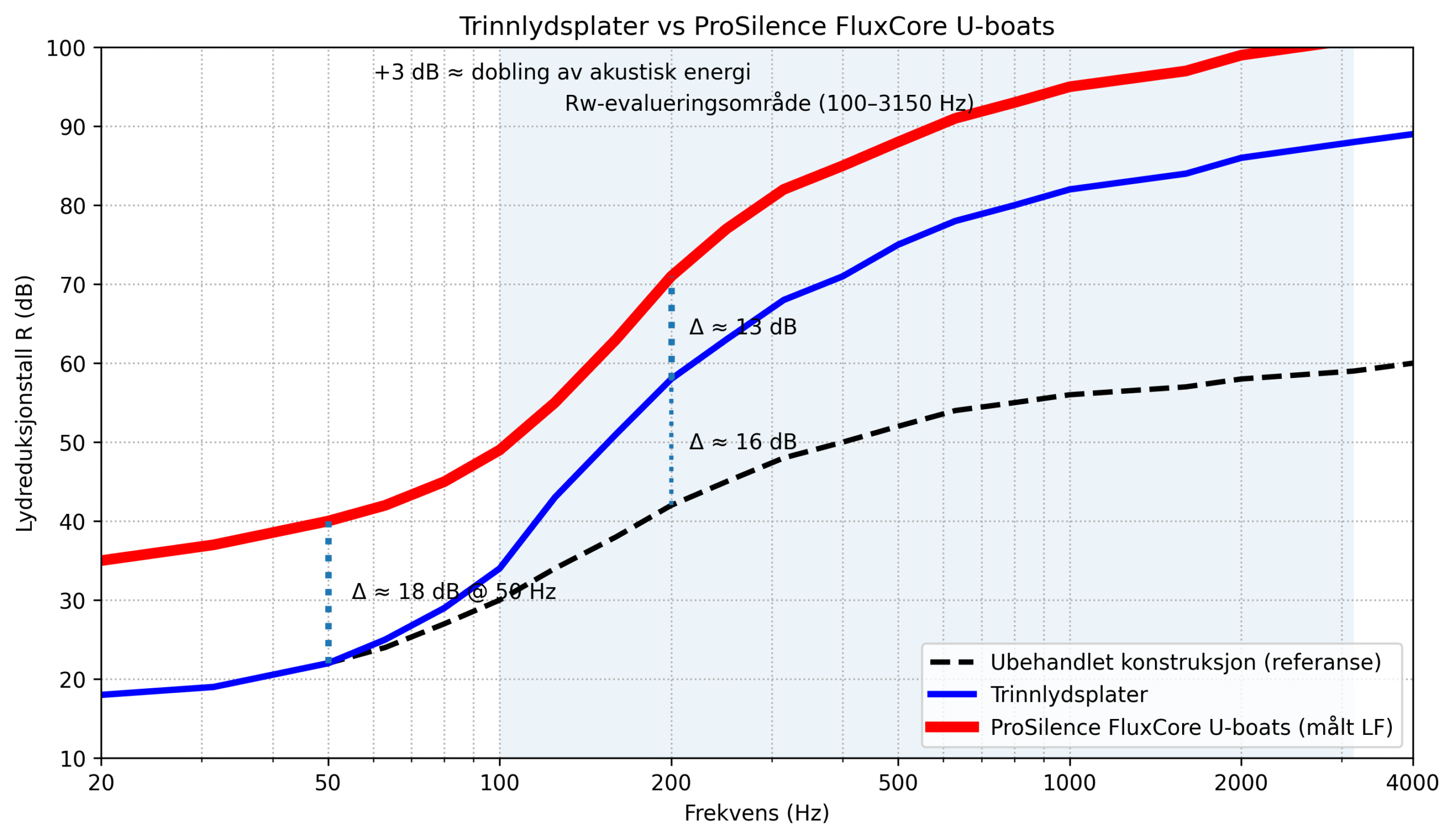
Conceptual comparison illustrating the difference between a spring-based floating floor and a conventional impact-sound underlay approach.
Separate the new floor
from the old one.
FluxCore U-Boats are installed underneath the floor stud structure, creating a resilient mechanical break between the new floating floor and the original slab or structural floor below.
The mass of the floor assembly loads the isolators into their intended operating range, allowing the completed structure to behave as a controlled mass-spring system.
B-s1,d0.
Engineered beyond vibration control.
The FluxCore U-Boat has been independently tested for reaction to fire and classified B-s1,d0 according to EN 13501-1:2018.
This represents a high level of fire performance for an elastomeric vibration-isolation component, combining limited contribution to fire, very low smoke production and no flaming droplets or particles.
High reaction-to-fire classification under EN 13501-1.
Very limited smoke production during the classification test.
No flaming droplets or particles observed within the classification criteria.
Tested according to EN 13823 and EN ISO 11925-2 as part of the EN 13501-1:2018 classification procedure. Classification applies within the field of application stated in the test report.
More than ordinary rubber.
FluxCore uses a specially developed silica-gel elastomer rather than a conventional hard rubber block.
The material system is developed for high elastic compliance, vibration damping, mechanical durability and a high level of reaction-to-fire performance.
Soft enough to isolate.
Stable enough to live on.
A floating floor must handle far more than its own structural mass. Cinema seating, equipment racks, subwoofers, grand pianos and heavy HiFi systems can all introduce substantial local loads.
Progressive resistance helps retain stability under occupied seating rows.
Particularly relevant where strong low-frequency vibration is generated in the room.
Floor systems remain usable with substantial point loads from equipment.
Suitable for studios and music rooms with heavy equipment and instruments.
High-performance decoupling
without a tall floor.
FluxCore U-Boats are designed around standard 48 mm timber or steel studs and add only approximately 34 mm of isolation height beneath the stud structure.
This makes the system particularly useful in retrofit and residential installations where available ceiling height is limited.
For rooms where the floor
becomes part of the acoustic system.
FluxCore U-Boats are designed for floating floors in environments where impact sound, low-frequency vibration or structure-borne sound must be reduced.
Control subwoofer energy and structure-borne bass transmission.
Mechanically isolate the floor from the surrounding structure.
Reduce mechanical energy transfer from loudspeakers and subwoofers.
Reduce impact and vibration from instruments and amplified sound.
Vibration must be allowed
to move before it can be isolated.
This demonstration shows how the compliant ProSilence isolation material moves under dynamic loading rather than creating a rigid mechanical path into the surrounding structure.
The isolator is only one part
of the floor.
Final isolation performance depends on the complete mass-spring-mass structure, including U-Boat spacing, floor mass, cavity design, perimeter isolation and flanking paths.
Correct loading is important: too little mass can prevent the spring system from operating in its intended range, while excessive or uneven point loading must be accounted for during design.
Simple installation.
System-level performance.
FluxCore U-Boats are positioned beneath the floor studs according to the required spacing and structural load. No special tools are required for the U-Boat itself.
Main specifications
| Technology | Progressive multi-stage mechanical floor decoupler |
| Primary application | Floating floor structures |
| Core material | Purpose-developed silica-gel elastomer |
| Recommended stud size | Standard 48 mm timber or steel stud |
| Approx. isolation height | Approx. 34 mm beneath stud structure |
| Target system resonance | Approximately 10 Hz under correctly designed and loaded conditions |
| Fire classification | EN 13501-1:2018 — B-s1,d0 |
| Fire test methods | EN 13823:2020+A1:2022 and EN ISO 11925-2:2020 |
| Primary performance range | Low-frequency structure-borne sound, impact energy and vibration |
| Installation | Positioned beneath floor studs; no special tools required |
Design the complete floor.
For demanding projects, ProSilence recommends designing the floor as part of the complete room-isolation system, including mass, U-Boat spacing, perimeter separation and flanking paths.
Find a dealer or contact DreamScreen Download datasheet Installation manual
Float the floor.
Break the vibration path.
Contact us for help calculating U-Boat spacing, floor construction and the complete ProSilence room-isolation system.
Find a dealer or contact DreamScreen