
MAXIMUM LIGHT.
MINIMUM COMPROMISE.
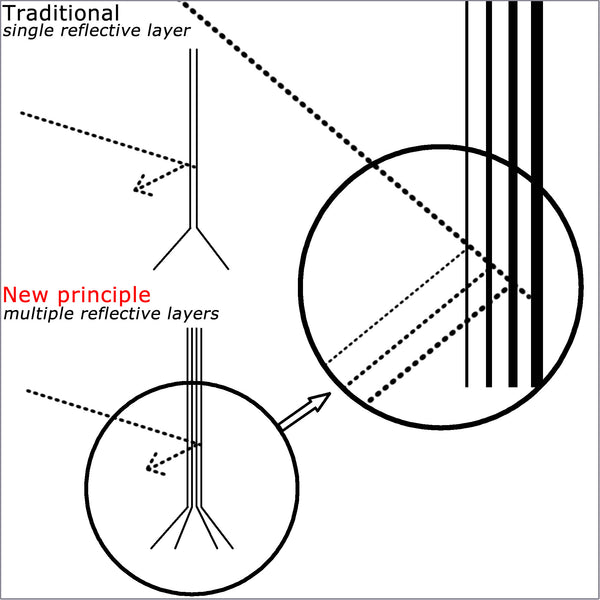
Our highest-gain UltraWeave architecture. Four factory-bonded layers combine an ultra-fine visible surface, three reflective layers and integrated black backing to deliver exceptional brightness while remaining highly acoustically transparent.

Three reflective layers.
One visible surface.
UltraWeave v7 was developed around one clear objective: increase light output as far as possible without abandoning the matte reflection principle or the acoustic transparency that defines the UltraWeave concept.
The solution is a four-layer bonded construction where the ultra-fine woven front surface works together with two additional white knitted reflective layers, while a fourth black knitted layer controls stray light.
Each layer has one job.
Together they do more.
Rather than forcing one coarse screen surface to provide brightness, resolution, sound transmission and light blocking simultaneously, UltraWeave distributes these functions across four bonded layers.
Ultra-fine weave
Defines the visible image structure and preserves fine detail.
Reflective knit
Adds light reflection while retaining high acoustic openness.
Reflective knit
Further increases total reflected light without defining the visible surface.
Black backing
Blocks stray light while remaining acoustically transparent.
0.93 gain.
Matte by design.
UltraWeave v7 achieves a professionally benchmarked D65 gain of 0.93, approximately 16% higher than the previous v6 generation.
Crucially, this increase is achieved through additional reflective textile layers rather than by adding a directional high-gain coating to the visible screen surface.

Bright without looking reflective.
Positive-gain coatings can improve measured brightness but often add sheen, hotspotting or visible surface structure. UltraWeave v7 instead retains the broad reflection characteristics of a matte screen.

Example of visible sheen from a more reflective screen surface compared with the matte UltraWeave principle.
Preserve the image.
Not the weave.
The visible front layer uses an extremely fine randomised weave, designed to approach the visual solidity of a conventional non-acoustically-transparent projection surface.

The randomised texture also eliminates the repeating geometric pattern that can interact with projected pixels and produce moiré.
The front layer defines the image.
The reflective layers behind the front surface contribute light, but the viewer still sees the ultra-fine structure of the front weave. This allows the construction to combine high reflection efficiency with a visually dense image surface.

Light stops here.
The fourth bonded layer is a highly acoustically transparent black knit. It prevents stray light from passing through the screen and makes loudspeakers, framing and other structures behind the fabric disappear.

Because all four layers are factory bonded, there is no variable air gap between reflective layers and backing that could otherwise introduce blooming or reduce perceived sharpness.
High gain.
Still highly transparent.
Adding a third reflective layer inevitably increases acoustic resistance compared with a lighter construction, but v7 remains highly acoustically transparent.
Measurements of the complete bonded structure, including the integrated black backing, show an average insertion loss of approximately 3.3 dB.

Built for very large images.
UltraWeave v7 is used in high-performance cinema installations where screen size and projector output make every percentage of reflected light important.
224-inch UltraWeave v7 installation combined with a Christie Griffyn RGB laser projector.

Developed through generations of UltraWeave.
DreamScreen's bonded multiple-reflective-layer construction is protected by patents granted in both the United States and Europe and represents the result of continuous UltraWeave development since 2005.
Designed for large-format cinema.
UltraWeave v7 is produced at approximately 2.3 metres / 90.5 inches fabric height and is available in selected roll lengths.
Suitable for 16:9 screens up to approximately 171 inches diagonal.
Suitable for 2.40:1 screens up to approximately 217 inches diagonal.
Purpose-built packaging.
UltraWeave is shipped together with an additional protective textile layer and suspended inside a double-tube packaging system to minimise the risk of damage during transport and storage.

Main specifications
| Gain | 0.93, D65 benchmarked |
| Acoustic transparency | Approx. 3.3 dB average insertion loss |
| Viewing angle | 160° |
| Reflection | Ultra-matte unity-gain principle |
| Supported resolution | >8K / randomised moiré-resistant surface |
| Construction | 4 bonded layers: 3 reflective + integrated black backing |
| Black backing | Integrated and factory bonded |
| Fire retardancy | US NFPA 701 certified C-s1,d0 according to EN 13501-1:2018. Documentation available on request. |
| Available sizes | See the current cut and TextileShield options in the selector above. |
| Accessories | Grip rails, UltraTucker Pro and DreamScreen frame systems |
Flexible to install.
Precise when tensioned.
The four bonded textile layers behave as one flexible fabric, allowing UltraWeave v7 to be tensioned using DreamScreen grip tracks or universal grip rails on custom frames.
Maximum UltraWeave gain.
Full cinematic transparency.
Need help choosing between UltraWeave versions, calculating fabric size or matching the screen to your projector and audio system? Contact DreamScreen before ordering.
Find a dealer or contact DreamScreenMaterial. Frame. Masking.
Prefer a complete screen? Combine an active UltraWeave fabric with an UltraFrame or IMASK system. Size and material compatibility are checked in the package selector.
Explore complete screen packages